A functional nanostructure should adapt to its environment. The central question is how to carry precise nanoscale features beyond a flat, rigid substrate.
01 /Published · 2026
SOLID & BIOLOGICAL INTERFACES
Let water do the transfer.
Water-floating nanotransfer printing
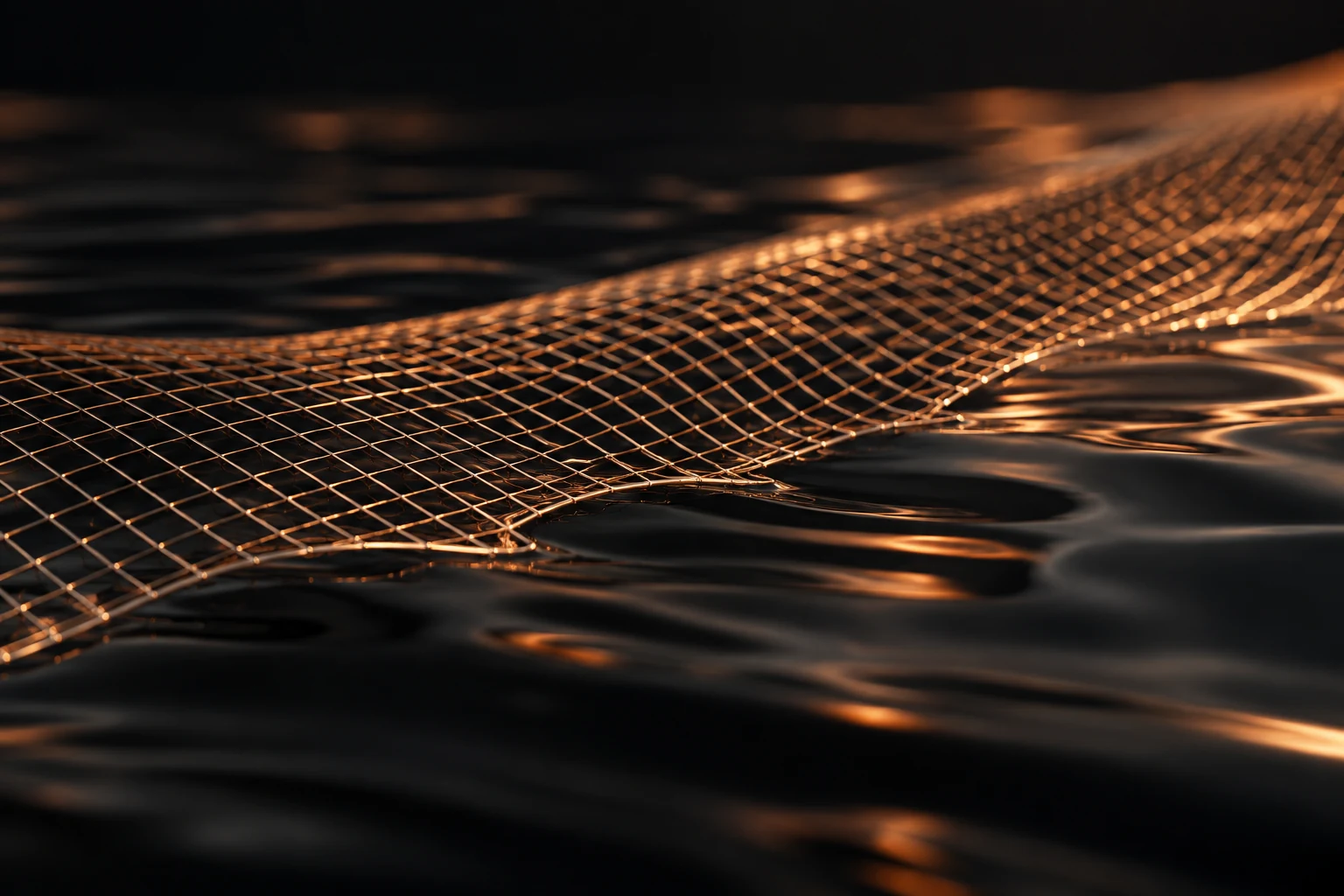
Floating metal nanomeshes are scooped onto curved and delicate surfaces. Demonstrations include pesticide sensing on plants and hydrogen sensing on fibers.
WF-nTPConformal integration
02 /Ongoing research
LIQUID INTERFACES
Sense at the surface.
On-liquid SERS
The floating state becomes a sensing interface itself. Plasmonic nanostructures are being developed for Raman analysis directly on liquid, without drying the sample.
SERSNanophotonic tongue
03 /Ongoing research
FIBROUS & DYNAMIC INTERFACES
Turn contact into insight.
Wearable & triboelectric sensing
Flexible sensing materials and contact-generated electrical signals are being explored for wearable monitoring and gas recognition, with physics-informed signal interpretation.
TENGElectronic nose
THE CONNECTING IDEA
A floating structure can be a transfer platform. Or it can become the sensor.
Solid surfaces receive the structure. Liquid surfaces host it. The interface determines the strategy.
RESEARCH CONNECTIONS
From a shared question to the next experiment.
Research interests span conformal nanomanufacturing, in-situ chemical analysis, and sensing on soft materials. Explore the KAIST research group for the broader context.